Showing posts with label Restaurant. Show all posts

A Lunch Visit to Chiavari - Our Favorite Ligurian City

Beautiful and Sophisticated - Visit Chiavari to Appreciate Liguria. 

Try Ligurian Specialties at Osteria Luchin - a Chiavari Insitution Since 1907.


Streets with colorful buildings & arcades in Chiavari, Liguria
Behind Piazza Mazzini, the streets become smaller as do the juxtapositions. These card players filled the street with shouts.

Chiavari couldn't be more peaceful. Although it was once a border city with mighty walls to protect against incursions by rivals such as Lavagna just across the Entella river, today it is unwalled and relaxed.  This part of Liguria has many slate quarries so a dark stone predominates, creating a comforting urban gravitas to complement the traditional warm Ligurian colors. Most of the beautiful streets have arcades supported on the street side by squat columns of diverse designs, and in the shadows of the arcades are specialty shops with elaborate old woodwork, bright pastry stores with mouth-watering window displays, and busy cafes with movie-set perfect patrons. On a recent Saturday morning the streets were filled with family after family shopping and doing errands, trailed by socializing pre-teens.

Mazzini speaks still on Piazza Mazzini in Chiavari, Liguria.
Mazzini speaks still in Chiavari, Liguria.
On the central Piazza Mazzini, the outdoor market was in full swing, as it is every morning. The huge assortment of colorful vegetables took up most of the space, but the cheese stands did their best to match the array, and the truck with roast meats added that great aroma to the market vibe.

The buildings around the piazza are a triumph of Ligurian variety. A bold gold building with dramatic window surrounds is next to a centuries old stained stucco building in need of attention, next to a vivid display of trompe l'oeil on a rose colored field..

On the west side is the white mass of the Palazzo di Giustizia. It's tempting to assume it's of ancient medieval origin, but it's from only 1886 in a style called Tuscan Gothic, which we presume is a disguised Italian slur.

A little further west towards the ocean is the Basilica cathedral of Nostra Signora dell'Orto. A very large church, it's not old by Italian measure but pretty interesting. It's origin is the 17th century, but it was refashioned in 1907. This influence provided an art nouveau feeling in the graceful golden embellishment inside.  In one chapel near the alter, there are works by Anton Maria Maragliano of Genoa, one of Liguria's most famous and original sculptors who worked wood in a style all his own.


Trompe l'oeil building facade on Piazza Mazzini in Chiavari, Liguria
Trompe l'oeil building facade on Piazza Mazzini in Chiavari, where the building diversity magically creates a unified city.

Osteria Luchin in Chiavari, Liguria.
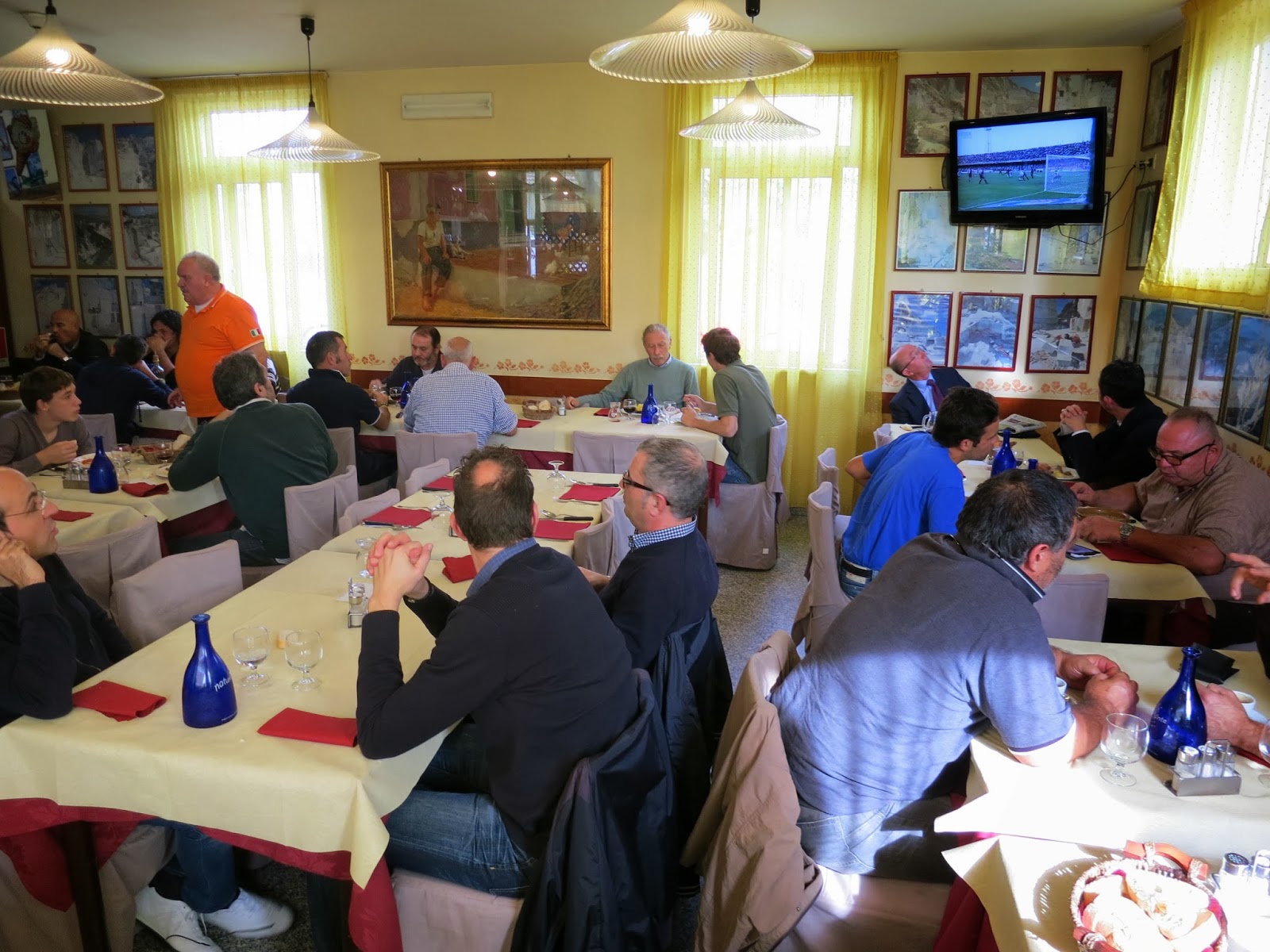
When the streets mysteriously become less busy, it means Italy is calling you to lunch. We once again chose a Chiavari institution with good food and an irresistible panache. Osteria Luchin was founded in 1907 and it's still going strong. It's popular because there's something for everyone, a really good variety, all at an affordable rate.  Passing through the doors will feel like passing back through time. It's busy and bustling with long tables used family style.

Menu Notes: many of the daily unique dishes are listed on chalk boards outside, and there's no information inside, so either have a look before you go in, or just wander back out and take your time.  Also. while they have an English language menu, it's not quite the same as the Italian menu, so if you can muddle through in Italian you'll have more choice.

The farinata oven is one of the reasons that Luchin is famous - the chickpea pancake is baked in very heavy pans so that the top gets brown and crispy while the bottom stays creamy and smooth.  We sat near the oven and could watch the whole thing - it's an art to balance the pan, shift it, keep the fire just right.  Lots of people got the farinata as an appetizer, it looked wonderful.

Below Mighty Massa Castle, a Perfect Tordelli Waits.

Tordelli are Tortelli are Tortelloni.  Enjoy this Many Named Pasta at a Tordellaria. 

Eat Massa's Unique Piatto Tipico in an Authentic Local Restaurant.

Malaspina Castle, Massa, Tuscany.
Malaspina Castle still watches over  Massa, Tuscany. CC by Richard  Avery.
At the northern end of Tuscany, hard by the sea and the Apuan Alps, is an interesting provincial capital with a crazy name - Massa. It is full of history and busy people and stone industry enterprise, and has its own lovely beach community. Although some of Massa's historic areas were damaged in WWII bombing, much of the historic center, and one of the largest and fiercest castles in Italy survived. The Castle of the Malaspina, established before 1,000 AD, and first mentioned in documents in 1164, is still powerful looking and fearsome. The Malaspina ruled the area known as Lunigiana for centuries and competed fist-to-fist with all who challenged.   It's fascinating to visit the castle, and you can tour it on weekend and holiday afternoons.  Generally the tours are in Italian, but we've experienced very helpful guides who recognize perplexity in an instant. For hours and fees, see: Castello Malaspina Massa

Dining room at Abacab Ristorante & Tordelleria, Massa, Tuscany, Italy.

If you'll be visiting the castle or are shopping in Massa, of course you'd like to know and try some of the food specialties. Well, there's a standout. Tordelli alla massese is rightly famous and it's delicious. It's made with a sturdy egg pasta, a rich and satisfying filling with a 'Massese' taste, and a sauce that's like the country cousin of bolognese: more robust, more sincere, more down to earth. The dish is so much a part of Massa that there are variations on the basic tradition, and there are both shops and restaurants devoted to tordelli.

The Perfect Italian Saturday - A Castle and Lunch

Visiting the Parma Countryside in Fall 

You’ve been traveling all week admiring the spectacular attractions of Northern Italy. Visiting Verona, Ferrara, Bologna and Parma was fabulous - but wouldn't it be nice to take a break from the cities? Yet it would be a shame to loaf around when there are so many treasures to discover. Here’s a way to enhance your Italy itinerary and see some of Italy's charming small towns and landscapes: castle hopping.

Torrechiara Castle near Parma
Torrechiara Castle and grape vines near Parma on a sunny day in November.
The provinces of Parma and Piacenza have many castles, and they are well presented at this link: Castles of the Duchy of Parma & Piacenza.  We chose the castle of Torrechiara in Langhirano, about 10 miles south of Parma, as an interesting Saturday junket. Parma is on the plain of the Po bordered by beautiful rolling hills. Not far from the city, the countryside becomes very rural – after all they don’t get that fabulous Prosciutto di Parma and Parmigiano Reggiano from urban areas!

The plains and low hills in the middle of Italy are often foggy –

Eating Well Above the Plain in Nicola

Ristorante Da Fiorella Dominates Lunigiana Bassa. 

Excellent Food and Huge Views in the Historic Hill Town of Nicola.

The hill town of Nicola overlooking the plain in lower Lunigiana.
The hill town of Nicola overlooking the plain of Luni. Beyond is the Caprione peninsula, Ameglia, and the Magra River.
Nicola is the most evocative village in the lower part of Lunigiana. High on a sharp little hill that bumps out of the coastal plain just before Liguria becomes Tuscany, it is poised for filming a movie set in the middle ages. So in truth, we didn't really need an excuse to visit twice. However, both times we just happened to visit around lunch time, and Da Fiorella was the only restaurant in town. Heh, heh.


Da Fiorella Bread & Focaccia
Da Fiorella. Bread & Focaccia
The restaurant is in a nice pink building with a stupendous view of the sea and the coast, and you are warmly welcomed when you enter. The first good thing is the first thing they bring you – an amazing bread basket. There's a focaccia topped with poppy seeds that's just the way you always hope focaccia will be – almost crispy, almost creamy, with seeds that really have flavor. Next in the basket is an excellent bread, and another focaccia with sesame seeds – if anything even more delicious.


The antipasto misto is not the usual selection of sliced meats. It has five portions - torta di verdure; torta of rice and onion; eggplant caponata; stuffed cabbage; and polenta incatenata, a creamy soft square of polenta with beans and vegetables just showing through. All except the caponata are flavored with great Parmigiano cheese. Each one is worth a sentence rich with adjectives - the flavors complemented each other perfectly, and left us enthusiastic for the primi.

Da Fiorella Ravioli con Ragu
Da Fiorella.  Ravioli con Ragu
On our first visit, we ordered two primi piatti. The first was house-made lunette, half moons of pasta filled with radicchio and gorgonzola, which came topped with chopped walnuts and drizzled with butter. Very enjoyable. The second was a thick soup of pureed chickpeas with fresh quadrucci pasta. Anything with chickpeas sounds like a simple dish, but it was actually extraordinary: the quadrucci were perfectly cooked squares of hand-made pasta that never got gluey, the ceci soup was nutty, and seasoned with a touch of fresh tomato, garlic, and oil. It was served with grated Parmigiano, fresh olive oil, and black pepper on the side.

On the second visit, two more primi. The first sounds a little predictable – ravioli with ragu. Da morire! The ravioli filling declared itself, but didn't control, and the meaty ragu played a great supporting role. A tribute to the kitchen for all the care brought to this dish.

Panigacci from Lunigiana Bassa
The second primi was panigacci and these continued our Lunigiana education. The best known panigacci from upriver Podenzano are made of wheat flour, mixed with salt and water until it forms a thick paste, and cooked in hyper-heated shallow bowls of clay, which are stacked so the top and bottom of the panigacci are cooked simultaneously. The resulting pancake-like jobbies are about 1/4 inch thick, and served with cheese and coldcuts, or even nutella. At Da Fiorello, however, a tradition from the Ligurian end of Lunigiana is preserved - they make crepe-thin panigacci in a cast iron pan, and while they’re still hot, roll them with fillings: one with pesto and cheese, the other with olive oil and cheese. The little brown spots on the panigacci added crunch and flavor, and they were a prefect primi. (Thanks to the excellent local website Le Cinque Erbe for: I Panigazi di Castelnuovo Magra).

Oven-baked Stuffed Rabbit
Oven-baked Stuffed Rabbit.  Coniglio Farcito al forno.
In our two visits, we tried three secondiDa Fiorella offers numerous grilled meats, and the Coniglio alla brace (grilled rabbit) we ordered was perfectly cooked, still juicy but thoroughly cooked.  The Coniglio Farcito al forno (stuffed rabbit) was more interesting though. The rabbit is, of course, boned, then topped with a thin layer of prosciutto and a stuffing that is rich, cheesy, eggy, the whole thing is rolled up and baked, and it's truly delicious, the flavors intermingling. Our other carnivore adventure was another local specialty, which you can probably tell is one of our weaknesses. The Agnello di Zeri, (Zeri lamb) - a little village in the mountains near Pontremoli in Lunigiana Alta - is famous for its tenderness and delicacy, and can be hard to find. This was oven roasted and tasted just as good as it sounds. The portion was generous and the pieces as meaty as a local lamb can be.

A lunch with due coperti, a ½ liter of the light but flavorful house red wine, and a one antipasto, two primi piatti and one secondo, cost 41E. The same with no antipasto, two primi piatti and two secondi, cost 47E. In our humble opinion, all of this combines to make Da Fiorella a regional treasure. They’ve been in business since 1970, and their mission statement is clear: they are dedicated to "cucina tipica" in order to offer visitors a voyage into the tastes and flavors of Liguria. Punto e basta, secondo noi.


Da Fiorella in Nicola di Ortonovo.
Ristorante Da Fiorella 

Via per Nicola, 46
Nicola di Ortonovo

Closed Thursday. Reservations advised.
Da Fiorella Website
Tel. 0187 66857
Cell 331 7451707   nicola.bertucci@gmail.com

In 2017, the name of the comune of Ortonovo was changed to Luni. Most signs still say Ortonovo.


Written by Martha

Osteria Gloria - The Pleasure of a Business Lunch

Slow Food Quickly Served 
Osteria Gloria,  Marina di Carrara


At the base of Carrara's marble mountains with the dramatic white quarries, in the flat, rather featureless industrial section of Marina di Carrara , is one of the most enjoyable restaurants in the area, Osteria Gloria.  A Slow Food recommendation for many years in their guide, 'Osterie d'Italia', this restaurant has complete authenticity.  Family owned and run, the place has been a standby since 1979. It is seconds from the autostrada exit, and no hungry traveler should pass it by.


Gnochetti with shrimp.


We went for lunch on a weekday in October.  It was packed, but, unusual for many Italian restaurants, they 'turn the tables', quickly setting up for new guests as happy people leave, and there was no wait.  The walls are covered with vintage pictures of the quarries: tiny workers posed by impossibly huge blocks of stone, with insignificant looking portable hoists and stone cutting tools littering the foreground.

There’s no written menu, but after your water and wine are delivered, a pleasant man with a short beard promptly appears and says in Italian ‘May I disturb you?’ and recites today's dishes. No antipasti were mentioned – it’s a work lunch, after all. For the primi piatti, they offered pasta with pesto, pasta with ragu, vegetable soup with faro, taglierini with beans, and gnocchetti with shrimp.  For seconds, they offered chicken involtini, fried calamari, seppie in humido with potatoes, tripe, anchovies, oven-roasted beef, and rabbit cacciatora.  Whew, that recitation went by fast!  Ancora, per favore!


Taglierini with fagioli.
We ordered the taglierini with beans and the gnochetti with shrimp to start. The soupy taglierini con fagioli is a Carrara specialty and it was hearty, of course, with lots of fresh pasta incorporated, a few delicious dark whole beans to add some drama, and it was accompanied by a liter of olive oil and a big bowl of grated Parmigiano - let your conscience be your guide.  The gnochetti were ½” light potato cylinders, about half the size of a typical gnocco, and just grainy enough to let you know how fresh and potato-y they were.  They were served  sauced with an oil that tasted just like the small shrimp that hid underneath.  This is the inadequate description of a really delicious dish.


Seppie in umido with potato.
For seconds, we chose the fried calamari, the lightest and freshest version we've ever enjoyed, and - the hit of the day - the seppie in umido.  Seppie are cuttlefish in English and they're cousins of squid and octopus. This dish had meltingly tender pieces of seppia, with a sauce just a touch piquant, and the potatoes falling apart to thicken the sauce. This, too, made the best ever list.  Rather surprisingly, there seemed to be no tomato in the sauce – our best guess: a simple base of celery, onion, and parsley, long stewed with a little white wine and a good fish stock.  I watched a man in a suit diligently mopping his plate, getting every bit of sauce with the very good bread they serve, and it was clear that this dish was a constant favorite.


Fried Calamari.

We wished we had room for contorni, which were salad, beans, greens, french fries, etc. but it wasn’t possible, and the desserts will have to wait, too.  After coffee, when we went to pay, the pleasant ending was that the whole wonderful mess including wine, water, and coperti only cost 34 Euro.


Lunch at Osteria Gloria.

Osteria Gloria is located at Via Covetta, 92, Marina di Carrara. Telephone 0585-53876.
Lunch and dinner daily. Closed on Sunday.

Directions: From the A12 Genova-Livorno, exit at Carrara and turn left after the tolls. Turn right at the first traffic light, and Gloria is about 100 meters down on your right.

Written by Martha

Carrara's Osteria Vittorio. The Tordelli Education

Where Every Day Is Fat Thursday

Tortelli becomes Tordelli in Apuana.                                                                                                        Osteria Vittorio, Carrara
Looking for the best lunch in Carrara can be kind of weird. It’s not a town oriented towards casual visitors, and while there are plenty of eating places, they’re often skewed more toward price than quality.

Osterio Vittorio - don't judge by the door.
Years of Carrara visits had passed for us, we tried lunches at restaurants large and small, but no great hits. Then we found a reference to a place serving authentic cucina Carrarina - Carrara cooking - right next to the anarchist bookstore. Irresistible. We went for lunch, it looked cozy, with yellow half curtains and an old fashioned entrance. By the time we sat down, we realized that we were the only ones there under 80. Old men sat alone at tables, all facing the same way, like sad fish facing a murky current. The food was sad, too. I got lasagne, which turned out to be little squares of plain pasta. No oil, no sauce, no salt! We moved it around for politeness, but didn't eat it. For a secondo, the menu offered veal in white wine. The veal was probably good, but it was coated in gummy flour, not browned, just floating in an unreduced wine sauce. Yuck. My dining companion - being both daring and clueless - got the tripe, which was a house specialty. It was mushy, tasteless, and the sauce characteristics that usually make it almost palatable, entirely missing .  We left more food than we ate.

Osteria Vittorio
And so for once our enthusiasm for lunch was low. After a visit to Carrara's Accademia di Belle Arti, we decided to try more restaurants from the same source that had recommended the catastrophe, just to see if they were universally wrong. We passed a few places by: a rather fancy French fish restaurant; a nice looking old cafe that was closed that day; a place that featured more cheap menus. We trudged to the last name on our list on Via Camillo Cavour, a bar where we were directed around the corner. We stopped short at the door to the restaurant. This wasn’t auspicious. There was a flashing neon ‘Aperto’ sign in one window, the venetian mini blinds were all drawn, many of the slats were bent or missing, and there was no sign of life. But the menu...well, let’s see, maybe it’s worth a try.

Osterio Vittorio, a legendary restaurant for Cucina Carrarina.
Push bravely through the door, and it’s as if you’ve been delivered. You enter a whole different restaurant than you imagined. Warm yellow table cloths, exposed brick, a marble chair rail – warm, cozy, almost elegant. We sat in a corner and started with an antipasto of crostone (bruschetta) with lardo and cherry tomatoes, and began to relax with the very decent house wine. We’d never seen lardo with a thin streak of actual meat before, but it was delicious, the warm crusty bread almost melting the lardo over the tomatoes. Perfect. 


Taglierini with fagioli.           Not Dean Martin's pasta fazool. 
For our primi piatti, in keeping with the piatti tipici theme (local specialties), we ordered taglierini con fagioli and tordelli. At first taste, taglierini with beans seemed a rather plain dish – fresh long pasta in a thick soup of flavorful beans. Kind of blah looking.  But the more you ate, the more you loved it.  Just so simple, comforting, delicious. Tortelli are tordelli in the dialects of the Apuan mountains.  They are big squares of pasta filled with meat and cheese and greens including thyme. Originally tordelli were made only on Fat Thursday (giovedi grasso) which is the pre-Lenten all-you-can-eat celebration that begins the week of Carnevale. In modern times, you just pay money. Sometimes served in brodo (broth) today they came with a rich, fabulous chunky ragu, and we ate every last molecule.


Ristorante Vittorio. Frittura di Terra with rabbit, chicken, zucchini, artichoke.

We only ordered one piatto secondo.  Called a Frittura di Terra, the platter of fried bits was ethereal, almost like tempura, with little chunks of chicken, of rabbit, artichoke, and zucchini served simply with a wedge of lemon. Really outstanding.

The owner is a local legend called Vittorino by all. We saw him gauge our chatting skills, and wisely he just gave us a smile and a nod - but while we waited for the check, homemade limoncino was delivered to our table, ice cold.


The bill for a starter, two primi, one secondo, house wine, and mineral water was 32 Euro. This is a great lunch place. Treat yourself: read up on Carrara speciaties and push through that inauspicious door.

Osteria Vittorio  (a/k/a Ristorante Vittorio)  Closed Wednesday  0585-71450   Google Map
Via Camillo Cavour, 28  (the entrance is around the corner on Via Cavatore)    Carrara (MS)
                          

Learning More  Here's a link to our Ugly Photo of la carta posted outside the Osteria the day we visited - you'll have to enlarge it to be readable (under View). Be aware that often the verbal menu recited inside will be different from the posting outside.

Read the Trip Advisor Reviews to practice your Italian - it's also a fun way to get clues on what to order.When we looked, there were 31 reviews - none in English (think about it - that's good).  One example: 'I tordelli di Vittorio sono una delle dieci cose che ci porteremmo su un'isola deserta...' (Vittorio's tordelli are one of the ten things we would take to a desert island....).

Carrara  The marble quarries are great, but there's much more in Carrara, see our story Carrara - Anarchy, Michelangelo, Marble.

Copyright 2013 APathtoLunch.com  Sign up to follow us, we don't spam, and we'll be grateful.

Written by Martha

A Charming Lunch in Charming Sarzana


Osteria Panzallegra in Sarzana, Liguria.
Even in the nicest spring weather, it rains sometimes. When it does, that's the perfect excuse (or the latest excuse) to go out to lunch. The small city of Sarzana is interesting in  many ways – historically, artistically, socially, and, more usefully, gastronomically. It serves as the informal capital of lower Lunigiana, that is the lower Magra Valley, and we are there twice a week for sure. There are more than a dozen decent restaurants in this town of about 20,000, and on a Sunday in April we finally got to try one of the places that’s been on our list for years – Panzallegra.

This last Sunday in April was the last day of Atri Fioriti, an annual Sarzana event in which the atriums of about a dozen historical palazzi are open to the public, with floral displays to enhance them.  It’s a simple kind of civic event and each site has informative signage and a few volunteer teens of differing levels of commitment.  One of the palazzi was the childhood home of the 14th century Pope Nicolo V, one of a famous local sculptor, Carlo Fontana, and it’s always fun.  We visited four or five atriums, and then started to look for lunch.  When we saw that Panzallegra was open for its last Sunday lunch of the season, we were in heaven - the handwritten menu outside was a Ligurian dream.

Ravioloni di Mare at Osteria Panzallegra in Sarzana.
Typically an Italian meal has four parts: Antipasto, Primo, Secondo, Dolce. Thirty years ago, one would have them all. Today, the diner has what they feel like, even to the extent of sharing portions. We would have loved to have the antipasto – there were 8 or 9 tiny exquisite ‘tastes’ on the plate, including marinated sardines, timbal of cauliflower, flan of onions, and so on…but our capacity is limited, so we started with primi piatti: lasagna al forno with pecorino and artichoke, and ravioli di mare, with cernia* and gamberi.  What can a speechless writer say? They were perfect. The lasagna had three layers of pasta, the pecorino was slightly aged but not tart, the artichokes smooth but with their characteristic bitiness.  No cheating here, everything freshly cooked, perfectly balanced.  The ravioli were even better, if that’s possible.  Four large ravioloni, so-called, filled with a finely chopped and delicately seasoned spoonful of fish, topped with a fresh tomato sauce with all the tastes of the sea in it.

Our second dishes lived up to the first. On one side, a plate of lightly breaded fried local lamb chops, served with lemon and a bitter palate-cleansing little pile of radicchio and lettuce. On the other side, a lovely fan of tiny fresh zucchini halves, stuffed with baccala mantecato and accompanied with a little berm of bechamel, flavored with a touch of fresh garlic and a little garnish of reduced balsamic vinegar.  Both dishes were terrific.

Baccala Mantecato at Osteria Panzallegra in Sarzana.

The service was attentive and friendly, and the owner explained each dish in understandable Italian. When I went to pay, I asked for a business card, and Maurizio introduced himself and beckoned Paola out of the kitchen.  I asked if these were her own recipes, and she said yes, all hers.  When I complimented them – particularly the puree of baccala, which was unforgettable – she said that their policy was freshness, purity, and simplicity.  They are one of the few restaurants in Lunigiana who qualify for the Slow Foods emblem of quality, well earned.


By the way, the price for this unique experience was modest and competitive in this area.  Two primi, two secondi, house wine and water came to 58 Euro.

Osteria Panzallegra  Via Mascardi, 21  Sarzana. Reservations advised. Telephone 338 2595915. See the website or call for opening times. They are open mostly in the evening from Wednesday through Sunday, and for lunch on Sunday from October through April.

Bed and Breakfast  Luci sul Golfo  Via delle Ville, 48A   Arcola (La Spezia) 338.2595915.
Maurizio gave me both the card to the restaurant and the card to the bed and breakfast that they run in Arcola.  At the level of welcome, cleanliness, and attention to detail that they show at the restaurant, I would stay there gladly. It is located on the outskirts of La Spezia in a quiet, hilly suburban neighborhood.

Baccala Mantecato Here's a nice recipe from an independent travel blogger, living VENICE

*Cernia is a fish called Dusky Grouper in English. We tediously debate the degree to which we ought to translate the terms. Our current arbitrary test: translate if the term would be unknown to a smarty pants on their third trip to Italy. Feel free to add your opinion.

Written by Martha

Italian Sunday Lunch in a Small City


Pranzo in Pontremoli
San Geminiano, the town's patron saint, holding the symbol of Pontremoli. The Ponte dei Quattro Santi, Pontremoli, Tuscany.

First of all, you have to come early.  No, you won't have to wait in line to dine, and no, you won't have trouble parking. It's because Pontremoli is a quintessential Italian small city.  It's a lovely and historic town and the center of Alta Lunigiana, as this part of Tuscany is known. To explore it is part of the whole Italian lunch experience.


One of Pontremoli's many bridges. This is the Magra River.
The history is practically endless.  Probably founded about 1000 BC, the town was a market center and seemingly always a hotbed of political activity.  The conflict between the rival Guelph and Ghibelline factions in the early fourteenth century in Pontremoli brought about the construction of the Great Bell Tower (Il Campanone) to separate the rival camps. (Ghibellines were the imperial party, while the Guelphs supported the Pope.) During these medieval times Pontremoli was a major stop on the Via Francigena, the famous pilgrim road between Canterbury and Rome. The ownership of Pontremoli changed often: the French, the Spanish, the Milanese, the Genovese all had a piece of the action.

In poking around the town, you can’t help but see all this.  The stonework, chipped and worn from centuries of use, the river arched by ancient bridges, the narrow alleys and palaces that are built of the local pietra serena, a hard gray sandstone that looks as peaceful and sturdy as it sounds.  Just walking around is wonderful. See More Information below to learn more details about Pontremoli.

A modern Stele statue.
But…if you have time, don't miss Il Museo delle Statue Stele Lunigianesi - the Museum of the Lunigiana Stele - it is fascinating.  The Stele are rudimentary human figures carved of stone, which are found throughout Europe, and which are up to 5,000 years old.  The epicenter, however, is here in Lunigiana, and the museum - in the Castello del Piagnaro - at the top of town has gathered the best collection of stele known.  They theorize that the small statues were used as border markers, or markers for where the best fords on a river existed, but in fact, it’s all speculation.  The statues themselves are sufficient.  Uncannily ancient, simple, powerful, they evoke a common humanity.  The museum is open 9.00 - 12.30 and 14.30 - 17.30 (closed Mondays).  If you can, it’s always good to check that the opening times are correct for the season (0187 831439).  Despite the lack of comprehensive English translations, it’s worth it to go – words and facts aren’t essential to feeling the presence of these statues.

Osteria della Bietola

For lunch, we chose Osteria della Bietola, a small and attractive restaurant in a tiny alley (luckily there’s a sign on Via Garibaldi, the main pedestrian way).  It’s a simple osteria with nice wooden tables in an old stone room, capacity for about 30 people (we reserved ahead 0187 831949). We were warmly greeted the owner,  Dani Alfonso, who also provided excellent service during the meal.


Tagliolini with ragu
Even though it’s Sunday lunch, we had already eaten a bit, so we regretfully skipped the antipasto.  There’s only one antipasto on the menu, the house special, with salumi (cold cuts) and the delicious local specialty torta d’erbe (vegetable pie), and it looked quite good.  But we went directly to the primi.  You can choose ravioli, tagliolini, gnocchi pontremolese (incorporating chestnut flour), gnocchi di patate, or testaroli (a local specialty similar to a huge pancake, often eaten with pesto). Then you choose a sauce: ragu, funghi, pesto, olio.  We ordered ravioli with funghi, and tagliolini with ragu, and they were both just the way you’d want them.

Ravioli with mushrooms
The tagliolini, made in house, were perfect - sturdy and still al dente without the slightest bit of gumminess, and sauced with a ragu that brought together a chunky meat base with just the right amount of tomato and vegetable -  and not a drop of oil left at the end. The ravioli are also made in house and have a filling of bietola (swiss chard) and ricotta, with the balance more green than white, which gives them a wonderful taste.  The sauce is tomato based, which was a surprise, and absolutely laced with dried porcini, creating a deep, rich taste.   Simple home cooking at its very best!


Coniglio Cacciatore
The seconds were also tasty and well-prepared.  The rabbit cacciatore is not your Little Italy cacciatore. This coniglio was very tender, no tomato at all, having been prepared with good olive oil with herbs and green olives.  The chef, Giuliana Massari, told me that the secret is in the herbs – sage, rosemary, thyme, and parsley.  I’ve made this dish at home, and my toque is off to her – she knows the exact right amount of each to enhance the rabbit.  The other second was grilled baby lamb chops, which, while delicious, were pan fried rather than really grilled, and so lacked the expected charcoally bits.


The house wine is a nice bottle of Chianti, which goes well with the food. We skipped the desert offerings of Tiramisu, Panna Cotta, and several fruit torta in favor of an excellent espresso.  Our entire lunch, which was all we could possibly eat today, was 53 Euro.

Chef Giuliana in her small but incredibly clean kitchen.

Osteria della Bietola
Via Della Bietola, 4A
Pontremoli MS
Tel. 0187 831949
Closed Thursday


More Information

Pontremoli Slow Food The food specialties of Pontremoli, such as testaroli, are described on this page of the indispensible Ciao Lunigiana website.

About.com Pontremoli Well informed travel info about Pontremoli. The author, Martha Bakerjian, is based in Lunigiana.

Terre di Lunigiana The Italian section of this extensive website has detailed information on Pontremoli and its surroundings.

Written by Martha

A New Restaurant in Old Lunigiana

Restaurant Alla Piazza di Sopra in Filetto.

Narrow street in Filetto, Lunigiana Tuscany
A medieval street in the Lunigiana village of Filetto.

Filletto is a tiny medieval-looking village built originally as an ancient stronghold.  Located just off the main road from Villafranca in upper Lunigiana, it is well known for its Mercato Medioevale every August, as well as its Mercatino antique market on the last Sunday of each month.  Charmingly, it is still surrounded by field and paddock, but this gem of a village is contained entirely within its quadrilateral defensive walls, most of which also serve as the walls of residences.


Since you can no longer drive through town, park outside the gate as you approach from Villafranca and walk through this different world.  There are all the wonderful accoutrements of an unspoiled medieval village –crowned and cobbled narrow streets, romantic-looking porched entrances, mysterious wall niches, and suspicious cats. Along the entry street, a large piazza opens with the village church on one side- a low old church - and opposite, a stone ramp leads up to a gateway.  Beyond that gateway is the Piazza di Sopra, also known as Piazza Immacolata, which was the original fort with four defensive towers. Directly across the piazza from the entrance gateway is Alla Piazza di Sopra, tucked into a corner.

The menu varies by season and availability of ingredients.
Alla Piazza di Sopra Ristorante opened last July (2011). The pride of the restaurant is the use of fresh, seasonal, local ingredients to create dishes typical of the area. Not only are the pastas made in-house, but the salumi are local as well. The offerings are  presented in a well-decorated, quiet dining room or, in warm months, at tables on the Piazza. A diner can immediately feel the sincerity of the proprietors, the Falorni family, and their desire to please their guests.  The mother, Tiziana, cooks with help from daughter and sommelier Laura, and  daughter Chiara is a patient and attentive server. A grandson runs in every once in a while for Italian authenticity.

On a recent rainy Sunday, three of us stopped in for lunch, and we really wished we had bigger appetites. The food was fabulous. The menu was presented verbally, and after serious bargaining between ourselves, we ordered. (Look below for a link to a sample menu in  Italian and English.)  Shortly after we ordered, we were served a pleasant and complimentary starter.  A decorative presentation of a circle of fried Parmigiano, a little wedge of honey croissant, and a dollop of absolutely fresh ricotta.

Our antipasti, photographed some bites late.
We ordered two antipasti to share. The first was, of course, the salumi – seven different kinds, including a house-made bresaola, several variations on cured sausage,  a delicate pancetta, a local prosciutto, and (we think) a culatello, garnished with one perfect strawberry.  The second was a dish of vegetable torte: cylinders of potato and Parmigiano, baked until just brown; delicate little towers of grated carrot, lightened by we know not what; pieces of a torte of tender pastry filled with a sweetly cooked filling of onions from Bagnone.  Somehow the serving included three portions of each dish – a thoughtful accommodation of our request to share.

Main dining room, Alla Piazza di Sopra.
For the primi, we had each ordered one of the special dishes, but of course we passed them around without shame every few minutes.  The first was Ravioli con Radicchio - ravioli stuffed with radicchio, garnished with pignoli and served in a sauce made with reduced Vermentino rosso.  It sounds complicated, but each of the tastes was clear and true.  The second was Testaroli al Pesto (who can resist?).  As tender as can be, with the perfume of the pesto preceeding it. It was a worthy representation of this local specialty. The third primi was Ravioli con Speck e Caprino, this  ravioli was filled with a great combination of smoked seasoned ham and creamy goat cheese, garnished with sauteed tiny cubes of pear and served with a sauce of gorgonzola.  Now that may sound pretty heavy, but this presentation was exquisite - everyone’s favorite. Tiziana the cook came out to inquire as to our reaction, and beamed – perhaps not for the first time – when we called it a miracle.

Typical ending at Alla Piazza di Sopra.
If we’d had enough appetite, we would have definitely ordered secondi. Especially true, since they offered the succulent Lamb of Zeri. We apologize for not describing every offering, but lunch will do that to you. We do remember considering Filetto di Chianina, Cozze Ripieno, and BaccalĂ  Marinato. The menu varies according to both the season and the availability of ingredients.  For example, the Ravioli con Speck e Caprino can only be offered when the fresh caprino is made.  In autumn, we were told, many of the chestnut specialities, including gnocchi, are on the menu. The website has the current menu with excellent English translations.

Piazza Immacolata, Filetto di Villafranca in Lunigiana.
The cost for two large antipasti, three primo piatti, coperti, water, and house wine was 54 Euro (2012). We felt it an appropriate price for the quality, service and pleasant ambience.
Alla Piazza di S. Sample Fall Menu It/En
Alla Piazza di S. Sample Spring Menu It/En

Alla Piazza di Sopra
Piazza Immacolata, 11  Filetto di Villafranca MS 0187-493796  or 349-8783364 cell
Email:  allapiazzadisopra@libero.it
Open for lunch and dinner Tuesday-Sunday. Open every day in summer.
Website: Alla Piazza di Sopra

Getting There
From Aulla head up the valley on SS 62, or from Pontremoli head down the valley on SS62 toward Villafranca. Turn east (away from the Magra river) from the SS 62 at a marked turn in Villafranca toward Filetto. Just 1 km ahead you'll see the narrow gateway to Filetto with its Do Not Enter signs.


Written by Martha
Copyright 2012 www.apathtolunch.com


The Italian Sunday Lunch

Menu A KM Zero
Sunday lunch in Italy is a huge cultural tradition. Far more than a meal, it is a socializing ceremony embraced by families, both nuclear and extended, couples of all ages, and groups of friends. It's also a boon to travellers who are facing a day of closed museums, shuttered stores, and reduced services.  It’s worth the trouble to find a restaurant that specializes in Sunday lunches, and reserve as early in the week as you can.  Many such restaurants are in rural settings, and people start arriving for lunch about 12:30, and the stragglers are generally there no later than 1:15. It normally takes two or three hours for the meal/ritual to unfold, depending on the number of people and the style of serving.


Recently, we had a terrific Sunday experience at Montagna Verde, in the hamlet of Apella in the town of Licciana Nardi. This is in the foothills east of Aulla in the northern part of Tuscany which is also part of a vaguely defined area called Lunigiana. (see Getting There and More Info below).   The wonderfully informative website Ciao Lunigiana had mentioned that five restaurants in Lunigiana were participating in the program Menu A KM Zero ( KM Zero is a new Italian term for local food) during October and November. Since Montagna Verde had won this competition in 2008, we e-mailed to make a reservation before coming to Italy.  The restaurant is part of an agriturismo venture in an old stone building with a tower high on a hill.  It has been completely restored with a restaurant, rooms, and a barnyard/garden.


Lunch, Dish by Dish
We were seated in a stone-walled dining room that rang with Italian voices – three large tables, a few four-seater tables, and just a couple of twos.  A bottle of red wine and a carafe of water were on the table, and after we settled and looked around a little, the procession began.  The antipasto was…beyond ample.  The first plates were local air-dried ham, local salami, and culatello, served with a bowl of warm sgabei, a fried dough that’s a local specialty, and a bowl of just-warm tiny lightly-pickled onions, the best I ever had.  When those were nearly gone, a plate with pieces of vegetable torte: one made with potato and leek; another with squares of fried polenta topped with the best mushroom sauce on earth; a third with squares of grilled flour pancake cooked with onions.  Next, two pieces of castagnaccio, a chestnut pancake, and a big dollop of amazingly creamy ricotta, made right there on the farm.  And to complete the antipasto, a sformata, a little tower of perfectly cooked farro with pignoli and a few sweet bits of minced grape.


Future castagnaccio.
You’d think that would be enough, and there was a break here to contemplate how good all those dishes were and to drink a little wine and a lot of water. We looked out the windows at the rusty fall foliage, watched the kids play outside, tried to eavesdrop on the other tables. We thought ahead about the pasta, but…the procession continued.. .and there were no decisions to be made. This pause allowed the staff to get the whole  room in synch, so that at just at the perfect time, the waitresses arrived with large white platters filled with tortelloni.  The squares of pasta were filled with a light porcini filling, and doused in butter that was flavored with sage.  The waitress put three large tortelloni in my dish and said quietly “there’s more coming”.  Three was ample, and, just in case, they came through again 10 minutes later to make sure everyone had enough.  This was getting serious, and there was another brief pause before the next platters came out, these heaped with home made pappardelle with a sauce of cinghiale.  It was a hearty mountain pasta, not one of the refined versions from the plains, and it fit wonderfully with the ambience.  And then the ravioli appeared, with a simpler but hearty sauce of lean beef and tomato.

This was getting dire.  Now the meat course is the one I can generally live without, but despite our plans, we found ourselves with a plate of perfectly tender stinco di maiale (roast pork leg), cooked with a bit of rosemary and garlic, and a heap of roasted potatoes.  And what fool could resist trying the second part of the third course - the local lamb, a bone-in piece topped with seasoned breadcrumbs and baked in the oven.  The meat of the lamb was mild, succulent, delicious, while the skin was crunchy.  At the end, we were forced to wave the white flag of surrender.  The manzo - beef strips topped with wild radicchio and shavings of Parmigiana smelled heavenly,  but it was physically impossible for us to continue.

After we sat for a while, marvelling at the stocky pensionati having seconds of lamb, digging into the beef as if they were hungry, we asked for coffee, and one of us had a small piece of ricotta pie, despite his previously stated intentions.  And then we sat for a while more, and prayed for accelerated digestion. The cost of this amazing meal for two was just 54 Euro, all inclusive.


A garden and farm animals provide diversion
 in the recovery phase after lunch.

All Sunday lunches aren’t usually like this, but they often have a ceremonial, processional element, and hurry is not in the cards.  It’s an experience you can’t have every week – you’d probably explode – but it’s more than worth seeking out on a lazy day.

Copyright 2012 www.apathtolunch.com. All Rights Reserved. This article appeared on www.apathtolunch.com and has not been authorized elsewhere.


Travel Tip_____________________________________________________________________
Renting A Car in Italy. If you drive in urban areas at home, you can drive in Italy. Car rental prices are important, but don't rent based solely on low price and stick to well known companies. We have two articles to help you:  Link: Independent Car Rental Reviews for Italy and Link:Car Rental Tips for Italy - Pick It Up Right 
In them, we recommend the car hire broker Auto Europe where you can compare companies, reserve with a low price guarantee, purchase no deductible insurance, cancel easily, and have 24/7 customer service before and after the car hire. If you will rent a car and want to do us a favor, please use this link: Auto Europe.
__________________________________________________________________________________
The views at Montagna Verde are huge,
and all the children are above average.

Getting There  Google Map Exit the A15 (La Spezia-Parma) autostrada at Aulla and follow signs toward Licciana Nardi and Villafranca which lead to the SS62 heading up the valley. Watch for a right turn toward Licciana. At Licciana follow signs to Tavernella. The left turn up to Apella is just after Tavernella, and the way to Montagna Verde is well signed.
                                                                
 More Info 

The list of all 32 restaurants participating in Menu A KM Zero is at the Parco Appennino website (IT) The restaurants are in the mountains in Lucca, Massa-Carrara, Parma, and Reggio Emilia provinces.

A typical Montagna Verde menu for this event can be seen at KM Zero Menu (IT)

Montagna Verde on You Tube A four minute television segment.(IT).


Written by Martha Bates