The Most Romantic Walk in Liguria - Lerici to San Terenzo
Travel Guide for Lerici - Attractions, Ferry, Bus, & Parking
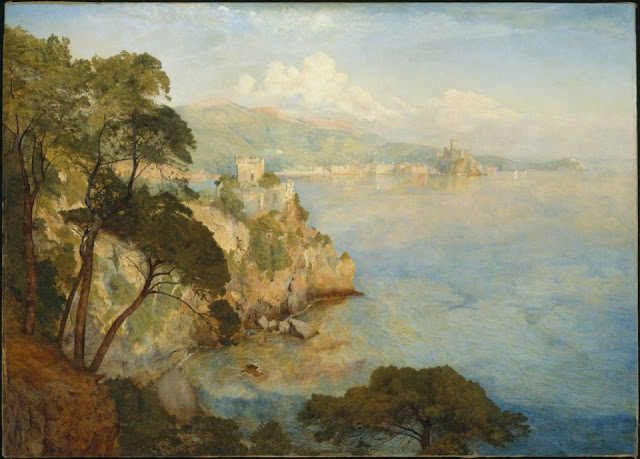 |
| Gulf of Spezia (1884) Henry Roderick Newman Museum of Fine Arts, Boston. |
Whatever romantic notions of Italy your soul harbors, this is the walk that will indulge them. The painter Henry Roderick Newman clearly felt the romance as he painted the San Terenzo/Lerici shore, framed by its two castles, over 125 years ago. Good writers and poets of every sort have striven to communicate the experience of these towns and this Gulf, and for good reason - this area is prose and it is poetry. Even though these villages and their little bays have been discovered as many times as love, it's your turn now.
The small harbor of Lerici has a lungomare (seaside walk) from the Lerici Castle to the Castle of San Terenzo, and a bit beyond. The walk has a wonderful Ligurian feel and is so full of sights and sounds that you can walk it 50 times - and we have - and not tire of it. The length is only about 3 kilometers each way, but you should allow at least a half a day, including a lunch or a dinner. There are two towns to explore, four beaches, two castles, many restaurants, many stores, a harbor, and, not least, lots of people. For ideas on where to stay, what to eat, and other practical info, scroll way down.
 |
| Colorful Lerici and Harbor. |
Read Below
The Walk from Lerici to San Terenzo
Arrival
Parking
Bus / Taxi / Boat Info
Where to Stay
Restaurants
More Information.
The Walk. Along this shore, the Gulf of the Poets - as it's been called for the last century - meets the land in a series of five scalloped bays. The order in which you encounter them will depend on how you arrive, but this description proceeds from Lerici Castle toward San Terenzo (i.e. toward La Spezia). Orient yourself by looking at our Overview Map.
 |
| Lerici Harbor and Castle at twilight. |
The largest bay is the harbor of Lerici, with its boat moorings overseen by its prominent castle. The castle was built by Pisa in the 1200's and is one of the most beautiful in Liguria, a superb example of military architecture. It is now a visitable Museum of Palaeontology, and it's worth a climb if only for the views of the Gulf, and the walk around the castle perimeter. The stairs up are accessible from the harborside molo (quay) which is interesting on it's own as there's a fish market, a breakwater, good views of Lerici, and the activity of the fishing and sport boats. When descending from the castle, follow the little alley-like streets inland and down. Walking among the crowded hillside buildings makes it easy to imagine the original town so different from the fashionable resort below. For more on one of these streets, Via del Ghetto, see our article The Jewish Ghetto of Lerici.
 |
| Piazza Garibaldi & San Rocco Photo-Paolo da Reggio |
These streets will bring you down, one way or another, to Piazza Garibaldi. This Piazza is lined with restaurants, cafes, and bars. It also has, on the sea side, one of the bus stops you might use for your bus or parking navette. Near the bus stop is the tour boat landing where you can get tickets or inquire about boats to Portovenere, La Spezia, Le Cinque Terre, Tellaro, Bocca di Magra, etc. Across the street from Piazza Garibaldi is the picturesque Oratorio and Tower of San Rocco. The tower began as a Roman watchtower and the Oratorio dates from 1287.
To the right of the church is Via Cavour, a charming little street that leads uphill. There are neighborhood shops, touristy shops, snack and food shops, and restaurants whose menus tantalize, including Bonta Nascosta near the top of the street. Tourists and locals bump along, everyone gawking at the shops and the menus and each other. When you come back down Via Cavour, turn right for more shops, including art galleries and an antique shop or two. Perhaps you'll notice a stairway or two leading off up the hill. Follow one up for a while and see a quieter part of the melange of history, resort, and hometown that is Lerici.
Travel Tip___________________________________________________________________
Our Hotel Guide & City Selector gives the Pluses and Minuses of other excellent Ligurian towns:
Part 1 Liguria Hotel Guide & City Selector Cinque Terre South. Lerici, Portovenere, La Spezia. Visit Cinque Terre & enjoy the Gulf of the Poets as well.
Part 2 Liguria Hotel Guide & City Selector Cinque Terre North. Levanto, Bonassola, Moneglia, Sestri Levante, Lavagna, Chiavari. Visit both Cinque Terre & Portofino.
Part 3 Liguria Hotel Guide & City Selector Towns on the perfect Portofino Peninsula.
Rapallo, Santa Margherita, Portofino, Camogli, Recco.
_________________________________________________________________________________
 |
| Lerici, Liguria. Walk along the Gulf of La Spezia. |
Along the harbor front across the street, you will be drawn to a shaded garden promenade that is our walk. The people watching is excellent here, since there is a playground and benches and an open area. You can pretty much depend on seeing grandparents with little babies, Senegalese sidewalk vendors, old guys trading opinions, and future soccer stars (note the no soccer sign). If you are here on Saturday, though, the market takes place along here, so the experience will be yet more lively.
As you continue to walk, you'll turn a corner and reach the small second bay called Lido, which is devoted to a pay beach club. It's seems quite family oriented, and always well maintained, but there's not much action. Soon the sidewalk rises and curves to the third bay, which is Venere Azzurra. This is much larger and there's more to watch. There are pay facilities as well as a free beach. This beach seems to attract more teens and young adults, so there's always something happening - a ball game, a card game, a splash fest, burying a friend, etc. There are a couple of snack bars, and the sidewalk serves as a kind of a peanut gallery where passersby can watch, leer, envy, compare, and study - all without embarassment. Halfway along Venere Azzurra there's a bus stop and also a little side street which leads uphill to the large parking area of La Vallata, mentioned below. If the waves are large, there might be some surfers on the far side of this bay. It's a kind of a theoretical surfing, however, as the waves never seem to cooperate, but the dudes get an 'A' for effort and persistence.
 |
| San Terenzo, Liguria. |
At the end of Venere Azzurra, around a small promontory one reaches the Bay of San Terenzo, the fourth bay. After passing a beachside hotel and pay beach, a lovely scene is revealed. San Terenzo - a string of oceanfront buildings with a church, apartments rising behind, a crescent-shaped, crowded sandy beach, and a castle on a small promontory. No major description is needed because the layout is obvious, but there's still lots to investigate. The beach here is more family oriented, but that's not to say conservative. The bus stop is at the waterfront, and the boat landing is on the breakwater pier. The well-situated San Terenzo castle is open limited hours, and it's interesting if for no other reason than this phrase from the entrance: "Unique in the entire world, the people built a castle."
 |
| Lo Scoglio, Mano di Dio. |
Beyond the castle, the fifth bay, Marinella, is a sheltered, cliff-lined little cove with a tiny beach. It is the foreground - without the walkway - in Mr. Newman's painting. The beach is so perfectly human-sized, there's always at least one person here, even if there's no hope of privacy. If you keep walking past a little gate on the far side, the sidewalk ends and there are views of the rugged Gulf shore. If the surf is heavier here, sometimes there's a 'thunderhole' where air, trapped by waves under the rocks, creates a great booming sound as it escapes.
Arrival By Driving You can arrive by ATC bus from La Spezia or from Sarzana (see below). You can arrive by boat, with much less risk than Poet Percy Shelly (see below). But most likely you will arrive by car. The center of Lerici and San Terenzo is a ZTL (Zone of Limited Traffic) in the summer (2016: June 15 to Sept. 15 10am-7pm & 10pm-3am) and possibly on special Saturdays, Sundays and Holidays on spring and fall weekends. In that case it requires a permit to enter, enforced strictly by police and cameras. Lerici has very clear ZTL signs with red and green traffic lights.
ZTL Details (IT).
Even when you can drive in, all the street parking is by permit, enforced with confusing signs. However, the town has provided satellite parking and two free 'Girobus' routes (little buses a/k/a navette) to make visiting possible. Note: If you are staying in Lerici, we would advise you to contact your hotel before you arrive to get the latest info.
Travel Tip___________________________________________________________________
Renting A Car in Italy. If you drive in urban areas at home, you can drive in Italy. Car rental prices are important, but don't rent solely on low price and stick to well known companies. We have articles to help you:
Link: Independent Car Rental Reviews for Italy
Link:Car Rental Tips for Italy - Pick It Up Right
Link: Where to Rent a Car from Cinque Terre? Also useful for Lerici.
We advise getting your car from one of the companies with the fewest problems reported (Avis, Europcar, Hertz, Autovia, Budget) either direct or via a reputable car rental broker such as AutoEurope (NOT autoeuropa, ending in 'a'). The advantages of using AutoEurope are the added services without paying more - low price guarantee; 24/7 help before, during, and after the rental; easy changes and cancellation; as well as available less expensive zero excess (deductible) insurance.** If you find our efforts helpful, you can thank us by making your reservation through these links -using the links do not raise your price.
AutoEurope(US) Auto Europe(UK)
Avis(English) Avis(IT) Budget Rental (Europe in English)
_________________________________________________________________________________
 |
| Gelato just tastes better when the sea is near. |
Parking There are three pay parking lots off the Statale 331, and one parking garage above the town center. See the Overview map for locations. By far the largest is the centrally located La Vallata. Coming from Sarzana, it's a signed right off the statale just after the tunnel Guercio (do not turn off to Lerici at the roundabout before the tunnel). Coming from La Spezia, it's also a signed right off the statale just before the tunnel Guercio. Parking fees are paid at a machine (coins only) and one leaves the receipt visible on the dashboard. In June, 2016, the rate at La Vallata was 1.50 Euro per hour 8 am to midnight, and parking is free on weekdays from October through April, according to signs on the machine. The rates and dates were a bit different at the other lots, so pay attention. Lastly, if you do get a ticket in the lot, locate and pay the attendant as it will be cheaper - so says yet another sign.
The Girobuses leave from the bus stops in the center and the top of La Vallata about every 15 minutes and cost just 1 Euro per day.
Girobus Routes Story with Maps One Girobus circles to Lerici and one to San Terenzo. Of course, you can also walk downhill from the La Vallata parking, and you'll join the walk description at Venere Azzurra. From the other two parking areas, you can catch the Girobus on the
statale or you can just walk downhill to San Terenzo and start the walk there.

The parking garage (unsuitable for large vehicles) above the town center is reached by following the road toward Lerici from the roundabout on the Statale 331. As you descend down into town, you'll encounter the ZTL sign at a tiny roundabout, and the entrance to
Parcheggio Lerici Centro is off this roundabout. Take a ticket when you enter, and pay at a machine on the lowest level as you return to your car. The rate in June, 2012, was 1.50 Euro per hour from 8am to midnight, and .50 Euro per hour overnight.
ATC Bus Info. We have written a riveting piece on bus transport
Getting Around La Spezia which will give you the skinny on the buses. If you are coming from La Spezia, midday buses leave about every 15 minutes. If you are coming from Sarzana, the buses run about every 1/2 hour. You can catch either bus at stops midroute, of course, and you can see the schedules and stops by going here:
Orario (Schedules). The La Spezia-Lerici route is L/S and it begins on pages 48 and it's ticket codice 3. The Sarzana-Lerici route is also L/S beginning on page 48 and it's codice 2. (As we write this, the ATC Google Planning function is down, so we are avoiding mentioning exactly where in La Spezia and Sarzana the buses travel). However, if you drill down on our Overview map (by Google), you'll see little clickable blue bus stops which give ATC route info.
 Boat Information.
Lerici is served by ferry boats that travel to Portovenere, and the Cinque Terre with connections for Palmaria Island and Portofino. The boats arrive and depart from a pier near Piazza Garibaldi. We have articles with complete times, prices, etc.
Cinque Terre Portovenere Lerici Boat/Ferry Schedules.
Taxi Information Taxi service is not expensive. From Lerici/San Terenzo to Tellaro, is 12 to 15 Euro. The taxi stand in Lerici is across the street from the boat dock. One Lerici cabbie, Antonio Venturini, can be reached at 338-1801707. In San Terenzo, the taxi stand is at the major intersection in town, and Giorgio's cell is 338-3403008, and Marco's is 347-2795158.
Travel Tip__________________________________________________________________
Where to Stay Use this Booking.Com.Italy link to find your hotel anywhere in Italy.
We hope we've helped you, thank us by considering the hotel or car rental links. Buon Viaggio.
If you'll be staying in a Lerici hotel, the following hotels are along the Castle to Castle walk. Listings are from Lerici harbor toward San Terenzo. If driving, remember to contact your hotel regarding entry to the ZTL. To see all Portovenere hotels listed, use this link:
Booking.Com.Lerici
Click on the Lerici hotel name for more information and booking.
The upscale
Doria Park Hotel is on the hill which overlooks the center of Lerici. It's quite close, but you must climb a bit coming back from town. The views of the Gulf are the compensation and its restaurant is well regarded. The entrance by auto does not involve the ZTL.
Right in town there's a well-rated apartment named
Ca' de Lerse (Lerici house in dialect) facing a garden, but located just off the central Piazza Garibaldi.
Hotel Shelley Delle Palme is close to the center of Lerici and on the
lungomare. There are balconies on the front rooms. On our very first trip to Liguria, we enjoyed a bottle of wine on one while watching a lightning storm highlight the Gulf's points of interest.
 |
| Hotel Florida overlooking Venere beach. |
On the little bay called Lido, further along the
lungomare, is the
Piccolo Hotel del Lido right on the beautiful Lido beach.
Hotel Florida overlooks the beach at Venere Azzurra, and also has balconies in the front.
Hotel San Terenzo is a hotel on the Lerici side of San Terenzo's bay. It is set below the
lungomare, close to the water and beach. It's new construction with access for disabled guests.
The little B&B
Il Nido is less than a 100 meters from the water, centrally located in the village of San Terenzo.
To Learn about staying in other Ligurian towns, read on:
Part 1 Liguria Hotel Guide & City Selector
Lerici, Portovenere, La Spezia. Visit Cinque Terre & enjoy the Gulf of the Poets as well.
Part 2 Liguria Hotel Guide & City Selector
Levanto, Bonassola, Moneglia, Sestri Levante, Lavagna, Chiavari. Visit both Cinque Terre & Portofino.
Part 3 Liguria Hotel Guide & City Selector Towns on the perfect Portofino Peninsula.
Rapallo, Santa Margherita, Portofino, Camogli, Recco.
_________________________________________________________________________________
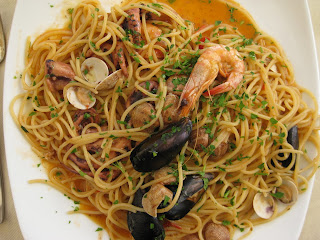 |
| Spaghetti allo Scoglio. Mano di Fatima |
Lerici Restaurants
For info on area specialties, see our article, A Guide to the Local Food of La Spezia. For help with Lerici restaurant options, see our notated map of this Caprione Promontory
, Restaurants Map. We've given info on restaurants we've tried, that Megan Guerrera of Bella Vita Italia has reviewed, and that a friend, Julie H., has tried. For planning purposes, note that the restaurants are concentrated more on the Lerici Harbor side of the towns. For picnic supplies, there are small supermarkets and prepared food outlets within an easy walk in both Lerici and San Terenzo.
More Information
 |
| Americans Abroad Gallery MFA, Boston |
MFA, Boston This article was prompted by the prominent display of the painting above,
Gulf of Spezia, in the Americans Abroad Gallery of The Museum of Fine Arts, Boston. It's in the recently opened wing
Art of the Americas. The
1884 oil painting is by Henry Roderick Newman, an American painter, (1843–1917) best known for his water colors. You can read a nice description of this work at:
MFA Gulf of Spezia and also click to a larger view.
NY Times Lerici The New York Times has discovered Lerici, and they sent a good and sensible writer.
Lerici Hikes. The Caprione peninsula on which Lerici is located has hikes every bit as enjoyable as those of Cinque Terre. We describe two in detail: The Forgotten Villages of the Gulf of the Poets and The Brides Walk, Ameglia to Tellaro
Some of our other Liguria Travel Articles
Getting Around La Spezia Describes parking in La Spezia, as well as bus info and other goodies.
La Spezia Travel Guide: Top Ten Attractions as told by people who have actually b
een there
.
The Most Beautiful Villages of Liguria Part 1 The Rock Villages A 7-part series covering 28 great little towns.
Written by Martha


