Showing posts with label Carrara. Show all posts

Osteria Gloria - The Pleasure of a Business Lunch

Slow Food Quickly Served 
Osteria Gloria,  Marina di Carrara


At the base of Carrara's marble mountains with the dramatic white quarries, in the flat, rather featureless industrial section of Marina di Carrara , is one of the most enjoyable restaurants in the area, Osteria Gloria.  A Slow Food recommendation for many years in their guide, 'Osterie d'Italia', this restaurant has complete authenticity.  Family owned and run, the place has been a standby since 1979. It is seconds from the autostrada exit, and no hungry traveler should pass it by.


Gnochetti with shrimp.


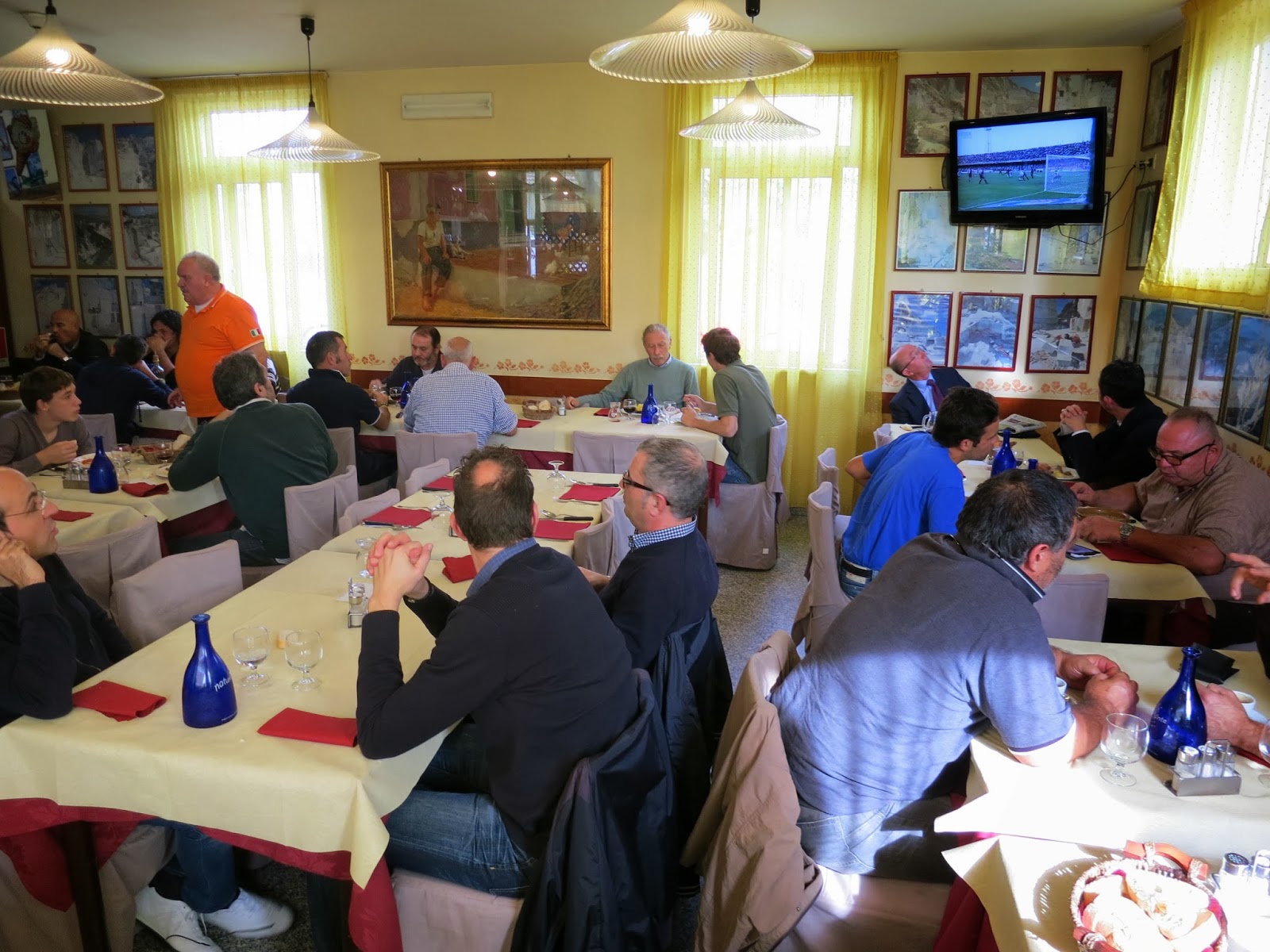
We went for lunch on a weekday in October.  It was packed, but, unusual for many Italian restaurants, they 'turn the tables', quickly setting up for new guests as happy people leave, and there was no wait.  The walls are covered with vintage pictures of the quarries: tiny workers posed by impossibly huge blocks of stone, with insignificant looking portable hoists and stone cutting tools littering the foreground.

There’s no written menu, but after your water and wine are delivered, a pleasant man with a short beard promptly appears and says in Italian ‘May I disturb you?’ and recites today's dishes. No antipasti were mentioned – it’s a work lunch, after all. For the primi piatti, they offered pasta with pesto, pasta with ragu, vegetable soup with faro, taglierini with beans, and gnocchetti with shrimp.  For seconds, they offered chicken involtini, fried calamari, seppie in humido with potatoes, tripe, anchovies, oven-roasted beef, and rabbit cacciatora.  Whew, that recitation went by fast!  Ancora, per favore!


Taglierini with fagioli.
We ordered the taglierini with beans and the gnochetti with shrimp to start. The soupy taglierini con fagioli is a Carrara specialty and it was hearty, of course, with lots of fresh pasta incorporated, a few delicious dark whole beans to add some drama, and it was accompanied by a liter of olive oil and a big bowl of grated Parmigiano - let your conscience be your guide.  The gnochetti were ½” light potato cylinders, about half the size of a typical gnocco, and just grainy enough to let you know how fresh and potato-y they were.  They were served  sauced with an oil that tasted just like the small shrimp that hid underneath.  This is the inadequate description of a really delicious dish.


Seppie in umido with potato.
For seconds, we chose the fried calamari, the lightest and freshest version we've ever enjoyed, and - the hit of the day - the seppie in umido.  Seppie are cuttlefish in English and they're cousins of squid and octopus. This dish had meltingly tender pieces of seppia, with a sauce just a touch piquant, and the potatoes falling apart to thicken the sauce. This, too, made the best ever list.  Rather surprisingly, there seemed to be no tomato in the sauce – our best guess: a simple base of celery, onion, and parsley, long stewed with a little white wine and a good fish stock.  I watched a man in a suit diligently mopping his plate, getting every bit of sauce with the very good bread they serve, and it was clear that this dish was a constant favorite.


Fried Calamari.

We wished we had room for contorni, which were salad, beans, greens, french fries, etc. but it wasn’t possible, and the desserts will have to wait, too.  After coffee, when we went to pay, the pleasant ending was that the whole wonderful mess including wine, water, and coperti only cost 34 Euro.


Lunch at Osteria Gloria.

Osteria Gloria is located at Via Covetta, 92, Marina di Carrara. Telephone 0585-53876.
Lunch and dinner daily. Closed on Sunday.

Directions: From the A12 Genova-Livorno, exit at Carrara and turn left after the tolls. Turn right at the first traffic light, and Gloria is about 100 meters down on your right.

Written by Martha

Carrara and John Singer Sargent

Beauty and Destruction in the Marble Mountains.
John Singer Sargent Watercolors
MFA Boston October 13, 2013 - January 20, 2014.

Wet Quarries  Carrara  1911                                                                                                         John Singer Sargent, MFA Boston
The great American painter John Singer Sargent was fascinated with white and with light, so his visit to Carrara to paint scenes in the quarries hardly seems surprising. The initial surprise is that this artist - famous for artistic and flattering oil portraits of the rich, the lovely, and the loyal - would express his interest in the world's most famous marble in watercolor. But Sargent was a serious artist first, and in an era of artistic flux, he chose to express his complete talent - and express he did.  He used the Carrara quarries to investigate a different aspect of his watercolor artistry.  Sargent's characteristic but subtle geometric composition is minimized, often replaced with disorder bordering on abstraction.   The colors are very different from other themes in the exhibit. Rather than the attention-getting multi-layered colors, he uses subtle whites with the rusty red-brown found in the fissures and topsoil around weathered Carrara marble.

Marmo Statuario, 1911                                                                                                                                         John Singer Sargent

This first major exhibit of John Singer Sargent's watercolors has just opened at Boston's Museum of Fine Arts, and his work from Carrara is one of several major themes in his watercolor effort. The show displays almost 100 Sargent watercolors and was organized by the MFA Boston and the Brooklyn Museum - each of which owns large collections of Sargent's work.  The show well illustrates the  vibrancy and the often saturated colors of Sargent's watercolor work, unexpected when presented to an art world accustomed to a watercolor being languidly transparent. One critic at the time said he was like, 'an eagle in a dove-cote'. About a dozen of the paintings are from his Carrara visit.

Lizzatori II, 1911                                                                                                                                                      John Singer Sargent


Like Michelangelo on his visits to Carrara 400 years before, the quarries demanded Sargent overcome the rigors of the harsh environment.  A friend recalled Sargent's devotion to the subject: "While painting at the Carrara marble quarries, [Sargent] slept for weeks in a hut so completely devoid of all ordinary comforts that his companions, far younger men, fled after a few days, unable to stand the Spartan rigors tolerated by their senior with such serene indifference."

Carrara In A Quarry 2                                                                                                                                          John Singer Sargent

The mountain workings that Sargent saw were very different from those that Michelangelo knew - and the difference was dynamite and steel cable, which came into use in the latter half of the 1800's. Using dynamite, the marble was blasted from the mountains with incredible inefficiency - about 90% of the marble so quarried became mountainside waste. Steel cable was more efficient, used along with a sand slurry abrasive, and it created a real industry. Sargent painted the disorder he saw - not majestic mountains, as he painted around the Simplon Pass. He painted the disorder of broken rock, broken mountains. Together the Carrara paintings help show the wonderful wide talent of the artist John Singer Sargent, and the dismal destruction of the marble mountains.

More Info

John Singer Sargent Watercolors MFA Boston  October 3, 013 to January 20, 2014
Villa di Marlia Fountain         Lucca 1910                     John Singer Sargent


The John Singer Sargent Watercolors will appear at the Museum of Fine Arts Houston  March 2, 2014 to May 26, 2014.

Watercolor.net Review Exhibit review with history and technique.

The New Yorker Blog Joshua Rothman reviews the show, July, 2013.

Full Sargent Biography The Wikipedia article on Sargent is extensive and well illustrated.

Written by Martha

Carrara's Osteria Vittorio. The Tordelli Education

Where Every Day Is Fat Thursday

Tortelli becomes Tordelli in Apuana.                                                                                                        Osteria Vittorio, Carrara
Looking for the best lunch in Carrara can be kind of weird. It’s not a town oriented towards casual visitors, and while there are plenty of eating places, they’re often skewed more toward price than quality.

Osterio Vittorio - don't judge by the door.
Years of Carrara visits had passed for us, we tried lunches at restaurants large and small, but no great hits. Then we found a reference to a place serving authentic cucina Carrarina - Carrara cooking - right next to the anarchist bookstore. Irresistible. We went for lunch, it looked cozy, with yellow half curtains and an old fashioned entrance. By the time we sat down, we realized that we were the only ones there under 80. Old men sat alone at tables, all facing the same way, like sad fish facing a murky current. The food was sad, too. I got lasagne, which turned out to be little squares of plain pasta. No oil, no sauce, no salt! We moved it around for politeness, but didn't eat it. For a secondo, the menu offered veal in white wine. The veal was probably good, but it was coated in gummy flour, not browned, just floating in an unreduced wine sauce. Yuck. My dining companion - being both daring and clueless - got the tripe, which was a house specialty. It was mushy, tasteless, and the sauce characteristics that usually make it almost palatable, entirely missing .  We left more food than we ate.

Osteria Vittorio
And so for once our enthusiasm for lunch was low. After a visit to Carrara's Accademia di Belle Arti, we decided to try more restaurants from the same source that had recommended the catastrophe, just to see if they were universally wrong. We passed a few places by: a rather fancy French fish restaurant; a nice looking old cafe that was closed that day; a place that featured more cheap menus. We trudged to the last name on our list on Via Camillo Cavour, a bar where we were directed around the corner. We stopped short at the door to the restaurant. This wasn’t auspicious. There was a flashing neon ‘Aperto’ sign in one window, the venetian mini blinds were all drawn, many of the slats were bent or missing, and there was no sign of life. But the menu...well, let’s see, maybe it’s worth a try.

Osterio Vittorio, a legendary restaurant for Cucina Carrarina.
Push bravely through the door, and it’s as if you’ve been delivered. You enter a whole different restaurant than you imagined. Warm yellow table cloths, exposed brick, a marble chair rail – warm, cozy, almost elegant. We sat in a corner and started with an antipasto of crostone (bruschetta) with lardo and cherry tomatoes, and began to relax with the very decent house wine. We’d never seen lardo with a thin streak of actual meat before, but it was delicious, the warm crusty bread almost melting the lardo over the tomatoes. Perfect. 


Taglierini with fagioli.           Not Dean Martin's pasta fazool. 
For our primi piatti, in keeping with the piatti tipici theme (local specialties), we ordered taglierini con fagioli and tordelli. At first taste, taglierini with beans seemed a rather plain dish – fresh long pasta in a thick soup of flavorful beans. Kind of blah looking.  But the more you ate, the more you loved it.  Just so simple, comforting, delicious. Tortelli are tordelli in the dialects of the Apuan mountains.  They are big squares of pasta filled with meat and cheese and greens including thyme. Originally tordelli were made only on Fat Thursday (giovedi grasso) which is the pre-Lenten all-you-can-eat celebration that begins the week of Carnevale. In modern times, you just pay money. Sometimes served in brodo (broth) today they came with a rich, fabulous chunky ragu, and we ate every last molecule.


Ristorante Vittorio. Frittura di Terra with rabbit, chicken, zucchini, artichoke.

We only ordered one piatto secondo.  Called a Frittura di Terra, the platter of fried bits was ethereal, almost like tempura, with little chunks of chicken, of rabbit, artichoke, and zucchini served simply with a wedge of lemon. Really outstanding.

The owner is a local legend called Vittorino by all. We saw him gauge our chatting skills, and wisely he just gave us a smile and a nod - but while we waited for the check, homemade limoncino was delivered to our table, ice cold.


The bill for a starter, two primi, one secondo, house wine, and mineral water was 32 Euro. This is a great lunch place. Treat yourself: read up on Carrara speciaties and push through that inauspicious door.

Osteria Vittorio  (a/k/a Ristorante Vittorio)  Closed Wednesday  0585-71450   Google Map
Via Camillo Cavour, 28  (the entrance is around the corner on Via Cavatore)    Carrara (MS)
                          

Learning More  Here's a link to our Ugly Photo of la carta posted outside the Osteria the day we visited - you'll have to enlarge it to be readable (under View). Be aware that often the verbal menu recited inside will be different from the posting outside.

Read the Trip Advisor Reviews to practice your Italian - it's also a fun way to get clues on what to order.When we looked, there were 31 reviews - none in English (think about it - that's good).  One example: 'I tordelli di Vittorio sono una delle dieci cose che ci porteremmo su un'isola deserta...' (Vittorio's tordelli are one of the ten things we would take to a desert island....).

Carrara  The marble quarries are great, but there's much more in Carrara, see our story Carrara - Anarchy, Michelangelo, Marble.

Copyright 2013 APathtoLunch.com  Sign up to follow us, we don't spam, and we'll be grateful.

Written by Martha

Carrara - Anarchy, Michelangelo & Marble

A Unique Carrara Attraction is the Character of Its People

Explore the Wonderful  Historic Center of Carrara with Added Insight

The Tuscan city of Carrara, and in particular the old town, is one of our favorite places in Italy. Many tourists visit only the famous Carrara marble quarries, and they are indeed worth visiting, but the town itself is unique and worth your attention. There are numerous historic and artistic attractions - like the famous Duomo, but another good reason to visit is the sense of place that Carrara radiates. Undefinable, indescribable, yet unmistakable, there's a feeling that this place has identity and this place has character and that the inhabitants know it, love it, and are proud of it.

Pop Art 1952 Cadillac Coupe de Ville MarbleCar in Carrara Italy
Pop Art 1952 Cadillac Coupe de Ville by Silvio Santini, Paolo Grassi, and Mario Fruendi, 1986. Weighing 31,000 pounds, The marble car took an entire year to sculpt from a single block of Carrara arabescato marble that weighed 154,000 pounds! Outside the 1840 neoclassical Teatro degli Animosi, or simply Gli Animosi, June 2012.

Here are three mini-articles describing aspects of Carrara, and some photos we like. Some pictures illustrate the words, most do not. Can you really not visit a place with a specialty called calda-calda*?

City of Anarchy
Carrara is the international capital of anarchy. We are not talking about masked, disaffected hotheads breaking windows, but rather anarchism as a political philosophy which 'seeks stateless societies based on non-hierarchical voluntary associations'. The International of Anarchist Federations is based here, and you can visit the anarchist Circolo Gogliardo Fiaschi bookstore on Via Giuseppe Ulivi. Nearby, there's the restaurant La Capineria where they sometime offer local Carrara specialties 'Sulle ali dell'anarchia' (On the wings of anarchy).


The baroque Palazzo dei Conti del Medico. Piazza Alberico. 18th Century. 
Every May 1 here, there is a large and sometimes very large demonstration called the Primo Maggio Anarchico attended by anarchists from all over Italy, and a number from other parts of Europe. The crowd is indistinguishable from any other political rally in Italy - all ages, all types, many signs. There are songs, including 'Sacco and Vanzetti' and 'Hymn of the International', the red and black anarchist flag, the anarchist symbol - an encircled A - and there's also a large contingent of idle carabinieri a few streets away, just in case. It is not a popular movement now, but it was influential in the late 19th and early 20th centuries, especially as part of the early labor movement. Important parts of the movement's evolution began here in Carrara.


Column capitol with pillow.
 Piazza delle Erbe, Carrara.


Anarchism became part of the stoneworker culture in the latter half of the 19th century. It was a natural affinity for people whose existence depended on the caprice of rocks and padroni, and whose ancestors included quarrymen slaves of the Romans. Their politics and their desire for betterment often led to confrontation with the quarry owners and the government, sometimes violent confrontation. In 1894, the 'Lunigiana Revolt' occurred here as anarchistic quarry workers went on strike and besieged police barracks in support of the Sicilian Leagues - a peasant rights movement (Fasci Siciliani). The uprising was violently surpressed by the state and 11 protesters killed. Read a fascinating, less-than-objective NY Times dispatch about the 1894 Lunigiana Revolt.


Monument to Meschi, Labor leader and Anarchist.


Anarchists were leaders in organizing the stoneworkers into unions. This led to improved working conditions such as the 6 1/2 hour day for quarrymen beginning in 1911. The anarchist Ugo Del Papa founded a Camera del Lavoro to coordinate and advance unions in 1904 and was influential in the successful strike of 1913. Even more influencial was Alberto Meschi, one of the beloved figures in the history of Italian anarchy. There is an interesting large monument dedicated to him in the lovely park of Piazza Gramsci (Piazza d'Armi) by the sculptore Ezio Nelli (1965).


City of Michelangelo
Old Carrara. Marble is used even in ordinary buildings.
Every visitor to the Vatican knows that Michelangelo travelled to Carrara to personally select the marble block to create the Pieta. However, very few know that 'selecting'  in 1498  meant dealing with a variety of tasks that were utterly remote from the graceful art that we see in a museum. Michelangelo visited Carrara about two dozen times in his life and the great artist stayed here for months at a time and lived in old Carrara. What trials and tribulations the great sculptor need to overcome in order to secure his marble! Selecting required attending to every aspect of procurement in an era where there was very little infrastructure. This meant prospecting the quarries, hiring the quarrymen, roughing out the blocks, arranging for transport to the docks, and contracting for ships to carry the marble to distant cities.

After reading Eric Scigliano's book Michelangelo's Mountain (click for his website - there's also an Amazon ad below to purchase) we can not only appreciate the sculptures more, but marvel that they exist at all. Mr.Scigliano's book describes in detail not only Michelangelo's involvement with Carrara, but the artist's life and career - masterpiece by masterpiece, as well as the milieu in which he lived. He describes nearly every aspect of the marble industry, both ancient and modern, and gives the reader a real appreciation of Michelangelo's determination to realize his vision no matter the obstacle.

Michelangelo lived and worked for months in this building
at the corner of Via Santa Maria and Piazza del Duomo.
The marble that Michelangelo used was, for the most part, quarried specially for him. In order to realize his work, the artist need to know which quarry owners were capable of supplying marble, as well as the qualities he desired in the marble - color, grain, veining. Quarrymen tend not speak of Carrara marble as a general term, but in terms of qualities - bianco ordinario, bianco venato, statuario, grey bardiglio or in terms of quarries - or parts of quarries - as a shorthand for a marble's particular characteristics. The Cadillac's arabescato is from the Cardellino quarry near Colonnata, Michelangelo's David is from Fantascritti in Misceglia, and the Pieta from Polvaccio. Carrara marbles all, but each with different qualities.


Once the possibility of obtaining a block of a certain marble was settled, he had to babysit the quarrying of the marble. Since the work was carried out with hand tools, a good deal of waiting was involved. Once quarried, Michelangelo would rough out the sculpture, both to reduce the weight for transport and to ascertain that there were no hidden faults such discolored veins, mineral inclusions, or cracks. If there were, the process began again.

There is little physical evidence of Michelangelo Buonarroti's residence in Carrara, but he did leave his initials in a fascinating place. In the 1st century AD, a Roman quarry slave carved an aedicula - a shrine - in bas relief on a wall overlooking the Fantiscritti quarry. It consisted of three small figures, Hercules, Jupiter, and Bacchus. It was an object of prayer by workers for protection and good fortune, and it survived for centuries. There Michelangelo carved his characteristic 'MB', and began a graffiti tradition. Eventually Bernini, Canova, Giambologna, and scores of other sculptors added their names. Ultimately it gave the quarry its name: fanti, Carrarese dialect for infanti - the three small figures - and scritti for writing.

A copy of the aedicula of Fantiscritti quarry. 
In June 1863, the aedicula was removed from the quarry, since weather and humans had taken a toll. It was placed in the Accademia di Belle Arti, where today it is its most famous holding. The Accademia was established in 1769 and is part of the Italian university system offering degrees in painting, sculpture, restoration, etc. It also is a museum open to the public. Located in the center of town in a former Malaspina castle dating from 1187, and is worth a visit. It has a copy of Michelangelo's plaster model for the 'Dying Slave', and a collection of plaster models from Canova, who also often came to Carrara to select marble. The Sala dei Marmi (Marble Hall) has an excellent collection of sculpture by many noted artists. The Accademia also continually hosts traveling shows.

City of Marble Trucks
In the industrial districts of Carrara, there are acres of stone storage yards filled with huge blocks of the characteristic white marble of Carrara, as well as many different stone blocks from around the world. These yards are primarily centered along the Via Aurelia near the autostrada and the quarries are located high above central Carrara. Yet, as you drive around downtown Carrara, you will not see any trucks carrying marble blocks.

The fountain to Duchess d'Este in Piazza Alberico.
Seen down one of old Carrara's narrow streets.


Until quite recently it was not so. The streets around town used to be travelled daily by hundreds of gigantic trucks carrying marble blocks which often measured 5 by 5 by 10 feet and weighed 40,000 pounds. These blocks were not strapped down in any way, but merely rested on the truck's bed! A disconcerting sight, but logical, since the blocks weigh much more than the truck. The trucks were 12-wheeled behemoths called 'bisonti' (bison, for their chunky powerful shape) which all but filled smaller streets and dwarfed passing cars. Although the trucks were restricted to certain streets, and were driven by experts (most descended from generations of marble moving families), they were nonetheless a unique and problematic characteristic of Carrara traffic.


Today, the marble travels on the Strada dei Marmi di Carrara, a road designated exclusively for heavy truck traffic (in business hours) opened in April, 2012. It runs south of Carrara proper between the lower quarry area at Miseglia and the Via Aurelia (SS1), 5.5 kilometers away. It took 9 years to construct since it was necessary to remove a million cubic meters of earth and rock and construct 4.5 kilometers of roadway through 8 new tunnels. The Strada cost 120 million Euro, shared between regional and town government and the marble producers. Since the road is downhill for loaded vehicles, both with blocks and marble rubble, the trucks are electronically monitored to insure the 50kmph limit is observed.

Copyright 2013 www.apathtolunch.com. All Rights Reserved. This article appeared on www.apathtolunch.com and has not been authorized elsewhere.

More Info
An outdoor cafe, Piazza Alberica. Carrara hosts an International
Biennial of Sculpture and numerous open air sculpture events. 
Carrara doesn't promote itself very well, so the more you read before you go, the better. In the old part of town there are descriptive plaques in Italian and English at the notable sites which are Via Santa Maria, Piazza del Duomo, Piazza delle Erbe, Via Ghibellina, Piazza Alberica, Teatro degli Animosi, Via Loris Giogi, Via del Plebiscito, Piazza Gramsci, and the Accademia di Belle Arti.

* Calda-calda is a local name for the Ligurian specialty of farinata which the dour might describe as an unleavened pancake of chickpea flour. In old Carrara, go to Pizzeria Tognozzi at Via Santa Maria, 12, where they also offer calda-calda as a sandwich inside the Ligurian specialty of focaccia....and you thought you were in Tuscany!  The piece of foccacia is split horizontally and stuffed with the farinata. Once we thought this was called a “cinque e cinque“, but we were sharply corrected: "No. That's the name in Livorno!".

The market day in Carrara is Monday, and the streets are more active and there's even more to look at.

Written by Martha

One Hundred Years A Minute

Walk The Ruins of Carrara'sMoneta Castle


Forest view on the way to Moneta Castle.
When the estate agent showed this piece of land to the city folk, the deal was as good as done. The neighborhood was developing fast, since the government had just created a huge subdivision at the border. Indeed, work was already in progress on the new regional capitol  nearby.  People were moving to the area, and it was just a matter of time before the best land was gone and prices rose. And what land! Views in every direction, easy access, mild climate, level areas with a southern exposure, and the previous owners had even put down foundations! The client - the Roman family of Monetii; the year - 200 B.C.; the land - a forested hill in Fossola off the road to Carrara; the new capital - Luni ; the previous owners - the Ligurian Apuani tribe.


Moneta Castle, the Apuan Alps, and Carrara marble quarries.
This is an easy walk in the Carrara frazione of Fossola, and it's only a few minutes from the autostrada - see Getting There below.  It will take you just 22 minutes of easy climbing to travel back 2,200 years.  The castle complex has expansive views of the sea, the city of Carrara and its valley, the Apuan Alps and the marble quarries. The ruins can be thoroughly explored, there are picnic places, and plenty of spots to sit and think. While the ruins are large, it's hard to imagine many of the buildings. Therefore, we've included a history section below to fuel your imagination.


View from the Castle of vineyards and the Carrara plain.
After you park, follow the tiny side road. It's paved for the first one-third, and it leads past garden plots, and a few half-hidden houses. It's shady and green, and you won't be out of a cat's sight for long. There are no decisions to make, and as you rise the gardens slowly end and forest takes over. Shortly, you'll see the ruins, and as you approach closely, follow in a clockwise spiral to reach the very top-most tower. The square tower was the original defensive tower, and then the campanile of the castle chapel. Note the worn threshold with a the pilgrim's cross nearby (photo below). As you follow around and down, you can easily imagine parts of the medieval borgo (castle village). Look for a round tower that we think must have been part of the defensive wall. Further along there's a doorway, partly made with white marble blocks that Professor Vita describes as the access to the keep (mastio). There are photos on the Italian websites mentioned below in More Info.
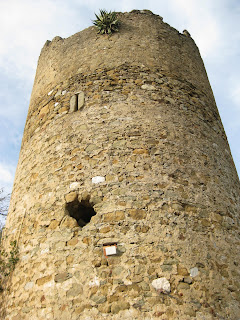
Tower of Moneta Castle, Carrara Italy
Castle Moneta. Defensive wall tower.
History. The history of this site is extensive and convoluted, but the telling is necessarily somewhat speculative as there are few documentary sources, and archaeological work has not been carried out on the ruins. We've tried to distill some facets of our reading to make your walk interesting.

The 'rustic villa' of the Roman Monaii family was established  at roughly the same time as the Roman empire began the city of Luni in 177 B.C. This strategic site was previously fortified by the local Ligurian tribe, the Apuani. The location was convenient to the ancient route called the Via del Sale, used for salt and other trading toward Lunigiana and the interior.   This area was then one of the frontiers of the Roman empire, as Roman expansion met the fierce Ligurian tribes of the coastal mountains. The conflicts with the Ligurians would last for over 300 years, and included a battle where 4,000 Roman legionnaires were killed. In another episode, 47,000 Ligurians were deported to the south.  The fortified villa became part of a defensive ring around Luni which included the present towns of Nicola and Ortonuovo and Avenza.

The fortified villa was transformed into a castle by the Byzantines while still a part of the Luni sphere in the 6th century. Subsequently, the Lombards (Longobards) took over in 643 AD, then Charlemagne's Franks in the 9th century. In the 10th and 11th centuries, while under the control of the Bishop/Counts of Luni, the castle was further fortified to resist the incursions of Normans and Arabs whose attacks finally finished off Luni.

Via Francigena. The Castle of Moneta was located on the medieval route known as the Via Pedemontana, (the foothill route) which led up and down the peninsula and was used to minimize the dangers and malaria of the coastal areas. Thus it was a stopping point for pilgrims making the pilgrimage between Rome, Canterbury, Santiago, and other holy sites, known today as the Via Francigena. It's easy to forget that there was never a single path called the Francigena. The route varied according to weather, hospices, brigands, rumor, and fad. The castle chapel threshold at Moneta shows the wear of centuries of feet, but also the welcome symbol for pilgrims in the cross carved in the stone (see photo).

Pilgrim Cross, Moneta Castle, Carrara Italy
The well-worn threshold includes a carved cross welcoming pilgrims. Moneta Castle, Carrara, Italy


Year 1455: The Maximum and Last Splendor. Many of the castle features that are evident today are the product of a large renovation carried out by one Spinetta di Campo Fregoso. Signore Campo Fregoso became the owner – by 1447 - of Moneta Castle as well as of Carrara, Avenza, and Castelpoggio Castles after the withdrawal of the Visconti of Pavia. The rebuilding lasted until 1455.

The renewed castle featured a larger borgo (castle town) below and around the summit surrounded by an elliptical wall. An additional defensive wall with robust round towers encircled the castle/borgo complex which now comprised half the hill. The castle's ancient square defensive tower became the campanile of a new castle church, and this is the high square tower still standing today. The dominant feature became a new imposing Rocca (castle keep) on the west side of the borgo. Three sides of the fortress were unscaleable sheer walls and the fourth faced the borgo with a defensive ditch crossed by a drawbridge and protected by an imposing tower. Additionally, huge underground cisterns were added, fed by local springs, to improve village life and add to the castle's defensive resources.
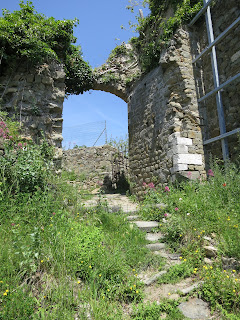
Ruins of Moneta Castle, Carrara Italy
Ruins of the gateway into Moneta Castle
Signore Campo Fregosi's rebuilding efforts were motivated by the arrival of effective uses of gunpowder. Although it had been introduced to Europe almost 200 years before, the development of weaponry was slow. However by 1447, gunpowder was being used successfully in siege cannons against medieval castles. The design of the new Moneta fortress with an outer wall was intended to prevent the approach of cannon. Unfortunately, Spinetta di Campo Fregosi's military vision was intrinsically medieval, and the development of more powerful and longer range artillery would severely limit the Castle of Moneta's military usefulness within a few decades, since it is surrounded by higher summits. Even the concept of a hilltop fortress would become outmoded as archery yielded to guns, and the range of weaponry increased. By the early 1500's, military architecture had begun to evolve quickly. The Sarzanello fort in nearby Sarzana was a transitional architecture constructed between 1492 and 1502 which shows some of the new design features. 

In 1476, the castle passed to Jacopo Malaspina of Fosdinovo, Marchese of Massa after the death of Spinetta di Campo Fregoso. Under the Malaspina, the castle began a long decline, never to regain importance. Military garrisons were stationed here for centuries, however, until the time of Napoleon. The castle was abandoned by 1804, and the property is now owned by the city of Carrara. There have been numerous restoration proposals over the last few decades, but still the ivy grows.

Getting There
V. Silicani turn at V. 20 Settembre
From the Carrara exit of the A12 Autostrada (Genoa-Livorno) follow signs in the direction of Carrara. This will lead to the large Viale 20 Settembre, which you'll join at a large roundabout where SS1 Aurelia and V. 20 Settembre intersect. About 2 kilometers after the circle, turn left onto Via Silicani in direction Fossola - see the photo.  We've made a  Google Map to help you.

Follow Via Silicani (which becomes Via Agricola) about 1.5 Km, as it becomes progressively narrower. Above, on a hill to the right, you can see the Castle ruins. At the second hairpin turn, you'll see a small sign indicating the path - see the photo below. Park here for the full walk described, or if you drive up the narrow road and park at a wide spot where the road turns to gravel, you'll be 1/3 of the way.

One can also drive close to the Castle ruins using Via Moneta, see the Google map.

Ameglia Montemarcello San Terenzo Panegacci Pontremoli Filattiera Copyright 2012 Mike Mazzaschi, Martha Bates www.apathtolunch.com. All Rights Reserved. Aulla Fivizzano Castelnuovo Magra This article appeared on www.apathtolunch.com and has not been authorized elsewhere. Cinque Terre Lerici Liguria Arcola Caniparola Massa Luni Testaroli Filetto Comano Mulazzo Zeri Sarzana Alpi Apuane Serra La Spezia

More Info
Beginning  of path is signed.
Italian Sites. Professor Renato Vita has provided extensive details and photos of the Castle of Moneta on two different sites. Castelli Toscani (IT) has a straightforward description, while Castelli della Toscana (IT)  is more detailed and a part of the extensive mondimedievali.net.

May 16. Every year around this date, the inhabitants of Fossola honor their patron, San Isidoro, with a procession to the Castle in medieval dress where a mass is celebrated. Fossola Procession Video  Check the local listings before setting out.


Panorama. If you continue up the auto road about 4km., now called Via Nuova di Fontia, to the frazione of Fontia, a very sharp left turn to the Santa Lucia Church leads to a stupendous panorama of the Versilia / Lunigiana coastal plain. The road has a sign indicating that it dead ends in 1500m.

Castles and Fortifications  Wikipedia is at its best providing complete castle information with these two entries.

Lunch
Osteria Gloria Located near the Carrara Autostrada entrance, this is an enjoyable restaurant for lunch. It doesn't get more Italian than this. Stone industry executives, port workers, truckers, and pensionati arrive for good food at a good price. The menu is verbal, and they don't get many tourists, but it's friendly if a bit hurried.  We can attest that the Insalata di Polpi, the Seafood Risotto, and the Seppie con Patate are good, and our bill for those three plus water and wine was 24 Euro! (11/2010)  It's listed in Slow Food's Osterie d'Italia as it deserves to be, (Via Covetta, 92. tel. 0585 53876 closed Sundays and holidays. Via Corvetta runs parallel to the autostrada on the Alpi side. ). Read our review: The Pleasure of a Business Lunch

Written by Martha

Marina Di Carrara - A Thursday Stroll

This is a really pleasant stroll on the perimeter of the Port of Carrara. We suggest that you combine it with a visit to the street market on Thursday as well as a walk around the streets of Marina Di Carrara. As there are mountain and sea views, it's best on days with decent visibility.

We have a map available at: http://www.communitywalk.com/marina_di_carrara_lunigiana__a_thursday_stroll/map/527097

In ancient times, Carrara marble was moved by boat under sail from Portus Mauricii on the left bank of the Magra river (now roughly at Fiumaretta). In modern times, it is handled in a large port which was purpose built. Fortunately, a walkway was included which allows pleasant views of the sea and the Alpi Apuane and the port activity. The ocean view is hindered by a large breakwater on the seaward side for about half the walk, but there's plenty to look at.

Driving south along the statale SS432 from Sarzana or Ameglia (here called Viale C.Columbo) turn right on Via Aldo Salvetti and park the car. This right is at the end of a pine-filled park and there's a large bar named Johnnie Fox's (under renovation 10/2010) on the corner. If you see ships and port activity, you've gone too far. If you arrive by autostrada, turn right from the exit, and this will lead you to the statale in about 1km where you turn left along Viale Columbo to reach Via Salvetti.

The walk begins inconspicuously on the left at the end of Via Salvetti, as you can see in the photo. The walkway then turns to lead straight out seaward and then turns left along the harbor. It is about 2.5 km round trip.


At the beginning there's a good local fish market (open every morning and afternoons until the fish are gone) and a playground, but quickly the sea dominates the walk. This photo shows the free beach with the Caprione Promontory (Ameglia, Montemarcello) in the background.

 
Once the walkway reaches the seaward arm, the views include the Alpi Apuane - the Marble Mountains - in the background, with the Port in the fore.

 
The walkway ends at the port entrance where fishermen and pleasure boats often gather.


When you're done, the Thursday street market can be found inland a few blocks and to the right (south). There are two good trucks selling roast meats, two good fish purveyors, as well as many vegetable sellers and the usual amazing and questionable fashions. See the map pin 5 for reference.

You'll also find a lively neighborhood of local shops if you head toward the Piazza Menconi. The stores include bread, fish, alimentari, and a gastonomia. The unassuming gastronomia is worth noting. Il Buongustaio at Piazza Menconi, 4,  has prepared foods as well as different sauces and fresh pasta (closed Monday). The selection is best about 90 minutes before meal time, and the food is good! Most of the shops are on the north side of Viale 20 Settembre and the streets near it. See the map pin 6 for reference.


Passeggiata
The harbor walk also combines with the nearby Viale Amerigo Vespucci to create a pleasant evening passeggiata. We happened on the area in late October when sunset coincided with the evening stroll around 6-7 pm. Crowds of retirees and lively young families made an especially enjoyable twilight.


We don't yet have a restaurant suggestion for you within walking distance, but we'd welcome yours.

However, a short drive away, the Trattoria Gloria  is a great place to go for a real Italian experience. It is a lively place full of marble industry memorabilia, and very popular at lunch. The menu changes daily and is presented  verbally in Italian. We can attest that the Insalata di Polpi, the Seafood Risotto, and the Seppie con Patate are good, and our bill for those three plus water and wine was 24 Euro! (11/2010)  It's listed in Slow Food's Osterie d'Italia as it deserves to be, (Via Covetta, 92. tel. 0585 53876 closed Sundays and holidays. Via Corvetta runs parallel to the autostrada on the Alpi side. ).
Written by Martha